
AI in Gaming: Transforming and Reshaping the Industry
- April 28, 2024
- Posted by: bluecast
- Category: Uncategorized
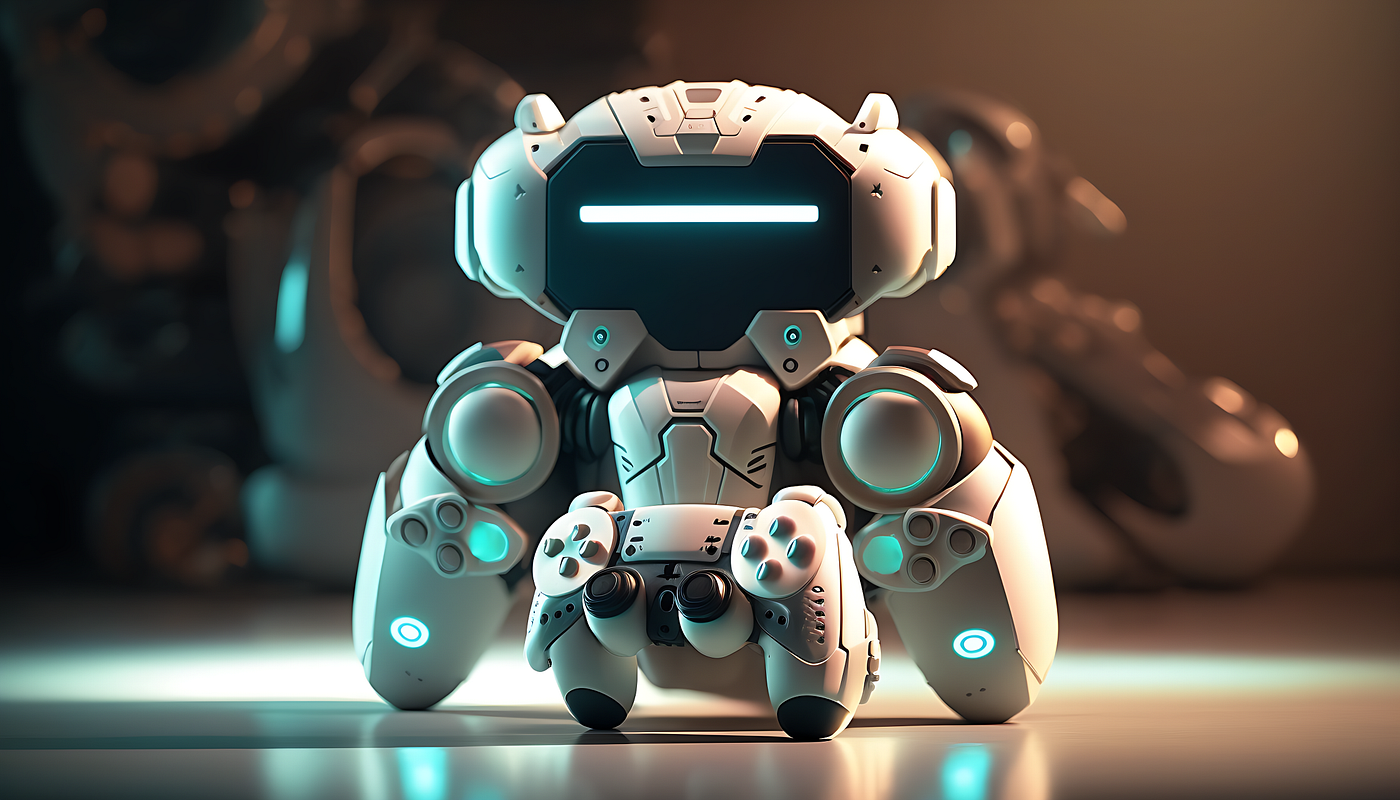
Video games have transformed from a pastime often dismissed by parents as frivolous to a thriving industry generating millions in revenue for teenagers and young adults. This sector also paves the way for advancements in AI and VR technology. Video game development integrates artistic and scientific elements of coding with disciplines like psychology, anthropology, cultural studies, and sociology. As a result, gamers develop proficiency in unique knowledge application areas, sharpening both social and technical skills at an exceptional pace.
The game development industry even birthed a new movement known as Creative Coding. While some sources define it solely as creating digital art through code, the gaming world expands this concept significantly. Creative Coding is actively practiced at game development conventions and incorporated into the curriculum of software engineering schools. It represents a unique blend of art, design, and scientific principles. This approach transcends conventional thinking, fostering the creation of extraordinary experiences where the physical and digital realms converge.
Game Dev coders endeavor to bridge the gap between the digital and physical worlds by enriching digital elements with the ability to interact with real-world environments. This allows digital information to become “embodied,” responding to the viewer, dynamically altering the context, and establishing intricate forms of interaction and behavior. Let’s see how AI and its disruptive tech counterparts like VR are currently transforming the gaming industry.
So, What is AI in Gaming?
Artificial intelligence (AI) in games extends beyond the boundaries of traditional interactive experiences. These systems learn about players’ behavior during gameplay, going beyond pre-programmed responses, which allows them to dynamically adapt and provide an optimal gaming experience tailored to each individual.
Role of Artificial Intelligence in the Gaming Industry
The likely reason why AI in the gaming industry strives, particularly in gaming, might be attributed not only to the fact that it is a lucrative market worth billions of dollars. The roots of this interest might stem from the deeply human nature of wanting to gain an advantage in a competitive field to achieve goals. Remember the Game Theory? It is a mathematical study that drives strategic decision-making among individuals and bigger entities like companies or even entire societies.
Despite the games being traditionally related to entertainment, scientists are working on some serious applications of AI by training their models in the gaming setting. Possible real-world scenarios include military training, education, driving training, medical training, and mental health therapy.
What’s more, game dev is at the forefront of software development innovation at scale. For instance, IEEE’s annual conference is a platform for presenting research papers. The latest findings are highlighted by the gaming giant EA:
A case study [for automated testing] is Battlefield V, which requires testing of 601 different features amounting to around 0.5M hours of testing if done manually. This corresponds to ~300 work years.
In response to these challenges, researchers are training Reinforcement Learning (RL) and other models, thus striving to rise beyond the limitations of scripted bots (while manual testing becomes increasingly obsolete). Additionally, developers spend thousands of hours on routine tasks like programming characters’ gestures, which could be automated with AI, freeing their time for more interesting tasks.
In this light, integrating AI in gaming and testing appears not just desirable but essential.
How is AI Used in Gaming?
Gaming industry seems to be leading the race in AI creation and evolution. The market has flourished with AI algorithms that are actually working in cloud gaming platforms and scaling on an ongoing basis.
Non-Player Character (NPC) Behavior
Older-generation NPCs are known for their unnatural body language, which results from their lack of responsiveness. AI engineers have figured out multiple ways of enhancing NPC behavior to make games more enjoyable. For example, smart NPCs were implemented in Unreal Engine. According to the original paper behind the research, scientists developed an algorithm based on the use of finite state machines and fuzzy state machines. Finite state machines adjust the NPC behavior based on a set of states (patrolling, chasing, etc.) that are triggered by events (seeing the player, hearing a noise). Fuzzy state machines allow for smooth and nuanced transitions between states based on fuzzy logic (spectrum of variables as opposed to binary logic). Additional models observed in smart NPCs are artificial neural networks that let them learn from experiences and genetic algorithms that let the behaviors evolve over time.
Procedural Content Generation
Machine learning algorithms can generate new levels, items, and quests. This can help keep games fresh and interesting for players, who will always encounter new content. Procedural simply means that developers do not let AIs go haywire while only letting them generate new content based on the predetermined set of rules. This helps them avoid unethical content generation and propagation. Generative adversarial networks work as an improvement mechanism where a generator and a discriminator work “against” each other, which results in more realistic and creative content.
Cheating Detection
AI can be used to detect cheating players. This can help to keep games fair for everyone. They do this by employing anomaly detection to identify and isolate deviating patterns. Supervised machine learning algorithms can be trained on cheating data and non-cheating data so that AI can understand the difference.
Dynamic Difficulty Adjustment
Similar to dynamic online exams where the questions adjust to the learner’s knowledge level, AI in the gaming industry can adjust a game’s difficulty based on a player’s skill level. This can help ensure that the game is challenging enough to keep it interesting, yet at the same time not frustrating. First of all, key metrics to track are identified, and tracking mechanisms are activated. For example, these could be time to complete a level, number of enemies killed, weapons used, etc. Then, the model of the player’s skill level is created. This model can then be used to predict how the player will perform on future tasks and adjust the difficulty accordingly.
Personalized Gaming Experience
Content recommendations that are familiar to us from most of the video and music content apps have also been implemented in cloud gaming. When a user logs into a game, they might be recommended items, heroes, and quests that they are more likely to enjoy. Furthermore, the whole game world can adjust based on the user’s preferences, including the landscape, quests, and AI companions. For example, No Man’s Sky introduced the possibility of creating a whopping 18 quintillion open worlds that are modified based on the player’s experiences.