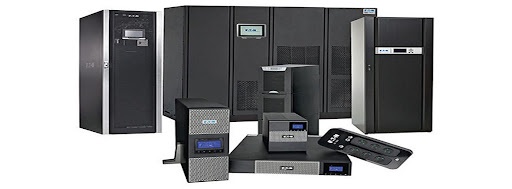
Power Backup Solutions
UPS (Uninterruptible Power Supply) solutions are critical components of infrastructure for ensuring continuous and reliable power supply to various electronic devices and systems. Here’s an overview of UPS solutions:
- Functionality:
- UPS systems provide backup power in case of mains power failure or fluctuations. They bridge the gap between the loss of utility power and the activation of backup power sources such as generators.
- UPS systems typically consist of a battery, a rectifier (to convert AC power to DC), an inverter (to convert DC power back to AC), and various control circuitry.
- They come in different sizes and capacities, ranging from small units for individual computers or home appliances to large systems for data centers, industrial facilities, and critical infrastructure.
- Types of UPS:
- Offline/Standby UPS: These are the simplest and most cost-effective UPS systems. They provide basic protection by switching to battery power when the input voltage falls below a certain threshold. However, there may be a brief interruption during the switchover.
- Line-interactive UPS: These UPS systems incorporate automatic voltage regulation (AVR) to correct minor fluctuations in input voltage without switching to battery power. They offer better protection than offline UPS systems and are suitable for small to medium-sized applications.
- Online/Double-conversion UPS: In these UPS systems, the load is always powered by the inverter, providing the highest level of protection against power disturbances. They continuously convert AC power to DC and then back to AC, ensuring a clean and stable output voltage regardless of the input power quality.
- Features:
- Scalability: UPS solutions can be scaled to meet the specific power requirements of different applications by adding additional battery modules or UPS units.
- Remote Monitoring: Many UPS systems offer remote monitoring capabilities, allowing users to monitor the status and performance of the UPS, receive alerts for potential issues, and remotely manage settings.
- Energy Efficiency: Modern UPS systems are designed for high energy efficiency, with features such as eco-mode operation, variable speed fans, and energy-saving modes to minimize power consumption and operating costs.
- Redundancy: In mission-critical applications, redundant UPS configurations can be implemented to ensure fault tolerance and system reliability. Redundant UPS units or parallel-redundant configurations can provide backup in case of UPS failure.
- Applications:
- UPS solutions are used in a wide range of applications, including data centers, telecommunications networks, healthcare facilities, manufacturing plants, financial institutions, and transportation systems.
- They are essential for protecting sensitive electronic equipment, preventing data loss or corruption, maintaining business continuity, and ensuring the safety and reliability of critical operations.